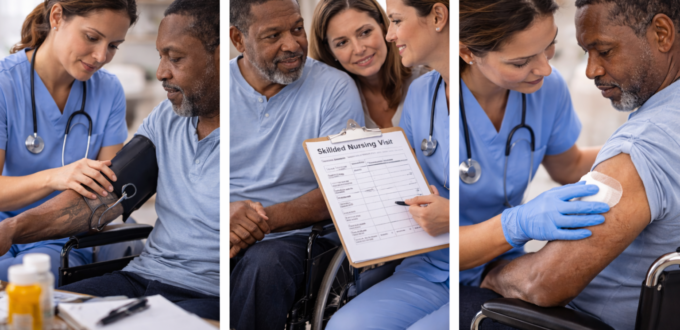
A skilled nursing visit is a short-term, medically focused Home Care service provided by a licensed nurse, usually a registered nurse or licensed practical nurse, in a patient’s home. Unlike ongoing Home Care aide services, skilled nursing visits are designed to address specific clinical needs rather than provide daily personal assistance.
The keyword is skilled. A skilled nursing visit involves medical tasks that legally require a licensed nurse. These visits are ordered by a physician and are tied to a defined medical goal, such as monitoring a condition, managing treatment, or teaching the patient or family how to safely handle medical care at home.
During a skilled nursing visit, the nurse may perform clinical assessments, monitor vital signs, evaluate symptoms, manage wounds, administer injections, oversee medication changes, or assess a patient’s response after hospitalization. Nurses also provide education, such as teaching a patient or family member how to manage medications, recognize warning signs, or safely perform parts of care between visits.
Skilled nursing visits are not meant to replace daily Home Care. They are typically intermittent, meaning they occur on a limited schedule, such as once or several times per week, depending on medical need. Once the medical goal is met or the condition stabilizes, skilled nursing visits usually end.
This is where many families get confused. Skilled nursing visits do not provide hands-on daily assistance with bathing, dressing, toileting, cooking, or supervision. Those needs are addressed through Home Care aide services, not skilled nursing. A patient may receive both, but they serve different purposes.
In New York, skilled nursing visits are often covered through Medicare or Medicaid when strict criteria are met. Coverage depends on medical necessity, physician orders, and the patient’s condition. Approval is not automatic and does not guarantee long term Home Care support.
Most patients who need ongoing home support qualify for Home Care services, such as PCA or HHA. PCA Home Care focuses on daily living assistance and supervision, and is the most common form of long-term home care. HHA Home Care may be required when medical complexity is greater, but it is still distinct from skilled nursing visits. Both PCA and HHA services are delivered through licensed Home Care agencies, not as one-time medical visits.
Skilled nursing visits are often used alongside Home Care, especially after hospital discharge. For example, a patient may receive short-term nursing visits to monitor recovery while also receiving Home Care aides to help with daily activities. Once the nursing need ends, Home Care may continue if authorized.
OPWDD services follow a different structure. OPWDD, which stands for the Office for People With Developmental Disabilities, focuses on long-term supports rather than episodic medical visits. Skilled nursing may be involved in OPWDD cases when medically necessary, but it is not the core service model.
Another important point is duration. Skilled nursing visits are time-limited by design. If a patient’s primary need is ongoing daily assistance, relying solely on skilled nursing will leave gaps in care once visits end. This is why understanding the difference early matters.
We help families understand when skilled nursing visits are appropriate and how they fit into a broader Home Care plan. We also help patients transition from short-term medical visits into stable, authorized Home Care when ongoing support is needed. All referrals are made only to top, vetted, and most reliable licensed Home Care agencies.
If you are unsure whether your situation requires skilled nursing visits, ongoing Home Care, or both, we can help clarify the right path. If you want to expedite the process and have an intake call with you directly, please fill out the eligibility form at https://familycaregiverny.com/eligibility-form.