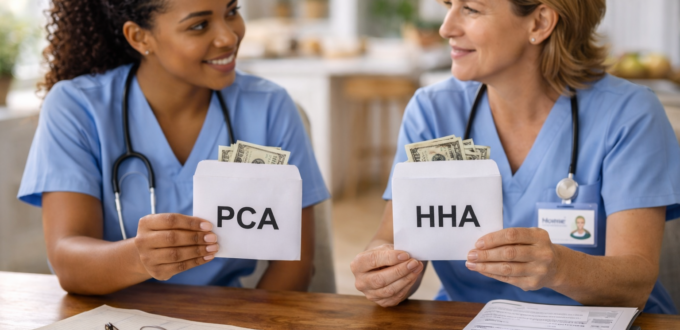
If you have been trying to figure out how to get home care for a loved one in New York, you have probably come across two terms more than any others. PCA and HHA. Personal Care Aide and Home Health Aide. A lot of families assume they are the same thing with different names. They are not. And understanding the difference matters because it affects what kind of care your loved one can receive, who can provide it, and how the entire approval process works.
We talk to families every day who went through the intake process expecting one program only to find out midway through that their loved one actually needed the other. It costs time and causes real frustration that could have been avoided with a clearer picture upfront. So here is a plain language explanation of what each program actually covers, how New York State defines them, and how to figure out which one fits your situation.
A Personal Care Aide, or PCA, is a certified caregiver trained to help someone with the activities of daily living. Getting in and out of bed. Bathing and grooming. Getting dressed. Preparing meals. Light housekeeping. Helping someone move around their home safely. Managing medications that have already been set up and organized by someone else. According to the New York State Department of Health, PCA training requires a minimum of 40 hours of approved instruction before a certificate is issued. A PCA cannot perform health-related clinical tasks. They cannot take vital signs, assist with medical equipment, or provide any form of medical assessment. The PCA role is designed for ongoing, day-to-day support with functioning, not medical care in the clinical sense.
A Home Health Aide, or HHA, does everything a Personal Care Aide does and more. The New York State Department of Health requires a minimum of 75 hours of approved core training for HHA certification, nearly double what is required for PCA. That additional training reflects an expanded scope of what an HHA is qualified to do. Under the supervision of a registered nurse or nurse practitioner, a Home Health Aide can check vital signs, assist with exercises prescribed by a physical therapist, help with more complex personal care needs related to a specific medical condition, and perform certain health-related tasks that fall outside what a PCA is authorized to handle. An HHA certificate is issued through the New York State Home Care Worker Registry, which is maintained by both the New York State Department of Health and the New York State Education Department.
The practical way to think about the difference is this. If your loved one needs consistent help managing daily life because of a chronic illness, a long-term physical disability, or the natural effects of aging, PCA is typically the right starting point. If your loved one has more complex medical needs at home, has recently been discharged from a hospital, or has a physician-identified care plan that involves health monitoring and specific medical tasks being performed in the home, HHA is likely the more appropriate level of care.
What determines which one your loved one actually gets is not something you decide in advance. It is determined through a formal home care assessment, which in New York is coordinated through the Medicaid managed care system. A nurse evaluates your loved one based on how well they can perform activities of daily living, what medical needs have been identified by their physician, and what level of support they realistically require. The outcome of that assessment drives the authorization, including which type of aide is appropriate and how many hours per week are approved. This is why the assessment matters so much and why having someone in your corner who understands how to accurately represent your loved one’s needs during that process can make a significant difference in what they are ultimately approved for.
There is one situation that surprises a lot of families and it is worth addressing directly. If your loved one qualifies for services through OPWDD, the Office for People With Developmental Disabilities, the certification required for their caregiver is not always PCA. Some OPWDD cases require HHA certification depending on the individual’s specific medical needs and how their care plan is structured. This matters particularly for families in the OPWDD self-direction program who are hoping to have a family member serve as the paid caregiver. If HHA certification is required for that specific case and the family member only has PCA certification, there is a gap that needs to be addressed before the case can move forward. We help families understand exactly what is required for their specific OPWDD situation before they start the process so there are no surprises partway through.
Both PCA and HHA services are funded through New York State Medicaid, which means they are available at no out-of-pocket cost to eligible individuals. Both involve a certified aide coming to your loved one’s home on a scheduled basis. Neither requires your loved one to leave their home to receive care. And for families whose loved one does not yet have Medicaid in place, that is not necessarily a dead end. The home care agency we work with offers free Medicaid enrollment support for eligible clients, which means getting coverage established can be part of the overall process rather than a separate obstacle your family has to figure out alone.
One more thing families ask us regularly is whether getting an HHA is always better than a PCA since the training is more extensive. The honest answer is that more training does not mean better fit. What matters is matching the level of care to what your loved one actually needs. An HHA authorization for someone whose needs are primarily non-medical does not add meaningful value and can sometimes complicate the approval process. The right level of care is the one that reflects what your loved one genuinely requires, documented accurately, so that the approved hours and services actually match real life.
We work with families across New York State who are navigating exactly these questions. Families in the Bronx, Brooklyn, Queens, Manhattan, and Staten Island trying to figure out which program applies to their situation. Families in Nassau County and Westchester who are coming out of a hospital discharge and need to understand what level of care was recommended and why. Families in Albany, Schenectady, Saratoga County, and the surrounding upstate areas going through the OPWDD process for the first time and trying to understand what certification their family member will need before they can begin.
If you are trying to figure out whether your loved one needs a PCA or an HHA, or if you are already in the OPWDD process and want to make sure you are on the right track, reach out to us. We will ask you a few straightforward questions and give you an honest answer about which direction makes sense and what the next step looks like.
Call or text us at 929-660-2391 or fill out the eligibility form. No cost, no pressure, and no complicated process just to get a straight answer.