
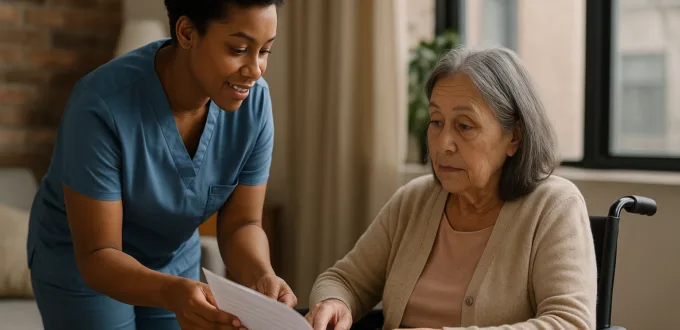
Families who begin paying for home care often face an unexpected financial burden. Even part-time help can become expensive, and many seniors eventually need daily assistance with personal care tasks such as bathing, dressing, meal preparation, and mobility. It is natural for families to seek ways to reduce these costs, and the question of whether home care services are tax-deductible often arises. The answer is that some home care services can be deductible when they qualify as medical expenses. Still, the rules are specific and do not always offer the relief families expect.
The IRS allows taxpayers to deduct certain medical expenses when they itemize their deductions. Home care services may fall under this category when they are medically necessary. This usually means the individual has been diagnosed with a condition that limits their ability to perform daily activities independently. Examples include dementia, Alzheimer’s disease, mobility impairments, chronic illnesses, and other conditions that require consistent supervision or assistance. The key requirement is documentation. A doctor must state that the person needs help with daily living tasks for health and safety reasons. Without this documentation, the IRS may not consider the services deductible.
Even when services qualify, deductions only apply when total medical expenses exceed a certain percentage of the taxpayer’s adjusted gross income. This threshold makes it difficult for many families to benefit. The care must be paid out of pocket, and the cost must be substantial enough to surpass the IRS limit. Many households do not reach this level because their income and expenses do not align to meet the requirement. As a result, the deduction becomes available only to a limited number of families.
Another complexity involves the type of care. When a caregiver provides medical care such as administering medications, helping manage chronic conditions, or performing tasks under a doctor’s instructions, those expenses are more clearly deductible. However, many seniors need help with personal tasks such as bathing, dressing, and cooking. These tasks are considered personal care and may only be deductible when the patient is unable to perform them due to illness or cognitive decline. For a person who wants convenience or companionship, the IRS does not treat the expense as a medical deduction.
Short-term home health services ordered by a doctor, such as nursing visits or physical therapy, are usually deductible because they are medical in nature. Still, these services are temporary and do not replace daily help. Most families learn that the real financial challenge lies in long-term personal care, not temporary nursing care. Deductions for personal care are possible, but the process is complicated and often less beneficial than families hope.
This is why many New York families choose not to rely on tax deductions as their primary strategy for managing care costs. Private-pay home care is expensive, and deductions only reduce taxable income rather than reimbursing the actual cost. Even when families qualify for the deduction, the financial relief is modest compared to the full expense of long-term care. Instead of viewing deductions as a solution, families often explore Medicaid-funded programs as a more dependable approach.
The PCA program is the most common Medicaid-funded home care option for seniors who need help with daily living tasks. PCA provides hands-on support with bathing, dressing, transferring, toileting, meal preparation, and household tasks related to health and safety. Once a senior qualifies for PCA, Medicaid pays for the caregiver’s services entirely. This eliminates the need for private-pay arrangements and removes the financial pressure that leads families to seek tax deductions. PCA also allows certain relatives to become the caregiver if they meet the program requirements and complete the necessary training through an agency.
Families sometimes consider CDPAP because it offers more flexibility in choosing a caregiver. However, PCA often becomes the more stable long-term option because it provides supervision, training, and reliable scheduling through an agency. Adult children who work full-time may not be able to offer consistent hands-on care, and a PCA ensures the senior receives the support they need without interruptions.
For individuals with developmental disabilities, OPWDD offers an entirely different system of support funded by Medicaid. OPWDD services cover personal care, skill building, and community involvement and are designed to support individuals throughout their lives. For families already providing care, OPWDD often becomes a more comprehensive and predictable source of help than private pay arrangements or tax deductions.
The most crucial point to understand is that tax deductions are limited and do not meaningfully reduce the cost of long-term home care. Medicare does not cover ongoing personal care, and private arrangements can quickly drain a family’s resources. Medicaid-funded programs such as PCA and OPWDD exist to solve this problem and provide sustainable support without the out-of-pocket burden.
If you want help determining whether your loved one qualifies for PCA or OPWDD and need guidance with the approval process, you can reach our team at FamilyCaregiverNY.com/contact.