
Searching for a paid family caregiver program in New York can get confusing quickly because there is no single program that fits every household.
The right direction depends on who needs care, their age and condition, whether Medicaid is active, where they live, and the proposed caregiver’s relationship to them. An adult with mobility problems may need a completely different Home Care pathway than a child with autism or an adult who sustained a traumatic brain injury.
Understanding those differences before starting an application can save a significant amount of time. Here is how the main programs and Home Care options compare.
PCA Home Care for Adults With Long-Term Care Needs
PCA Home Care, or Personal Care Assistance, is generally the first program to consider when an adult needs ongoing help at home due to a physical disability, chronic illness, mobility limitations, dementia, or age-related decline.
Personal Care Aides can assist with approved daily activities such as bathing, dressing, toileting, walking, transferring, meals, personal hygiene, and other tasks included in the patient’s plan of care.
New York introduced Minimum Needs Requirements for many people seeking Medicaid Personal Care Services. For assessments occurring on or after September 1, 2025, certain applicants must demonstrate a specified level of assistance with activities of daily living. A separate standard applies to some people with dementia or Alzheimer’s disease.
You can review the current requirements on the New York State Personal Care Services page.
Can a family member be the PCA caregiver?
Through the PCA family caregiver pathway supported by the licensed Home Care agencies we work with, certain extended relatives and trusted people may be considered for employment as the patient’s caregiver.
Possible caregivers may include:
- Siblings
- Grandchildren
- Cousins
- Nieces and nephews
- Other qualifying extended relatives
- Trusted family friends
Spouses, adult sons and daughters caring for a parent, in-laws, and legal guardians are not eligible caregivers under the PCA pathway we support. Living at the same address may also create restrictions, so we check the relationship and living arrangement before moving a case to the eligibility form.
A caregiver hired as a Personal Care Aide must also satisfy the licensed agency’s employment and training requirements. New York’s standard PCA basic training program includes at least 40 hours of approved training.
OPWDD for Children and Adults With Developmental Disabilities
If the person needing support has a qualifying developmental disability, OPWDD services may be the more appropriate direction.
The New York State Office for People With Developmental Disabilities serves eligible children and adults with developmental disabilities such as autism, intellectual disability, cerebral palsy, and certain neurological conditions. OPWDD eligibility generally requires evidence that the developmental disability occurred before age 22 and that the applicant meets the program’s other eligibility requirements.
OPWDD Self-Direction can give an eligible individual greater choice and control over authorized services, staff, and supports. New York’s own Self-Direction assessment describes the model as allowing people to customize services around their individual needs and preferences.
Parents and legal guardians are not accepted as paid caregivers through the OPWDD provider pathway we support. Depending on the approved services and provider requirements, a sibling, cousin, extended relative, or another qualified worker may be considered.
Learn more about official eligibility requirements on the New York State OPWDD eligibility page.
Quick Program Comparison
| Situation | Possible Starting Point |
|---|---|
| Adult with a chronic illness, physical disability, dementia, mobility limitation, or age-related care needs | PCA Home Care |
| Child or adult with a qualifying developmental disability that began before age 22 | OPWDD |
| Adult with a qualifying traumatic brain injury who meets nursing facility level-of-care requirements | TBI Waiver |
| Patient needs personal care plus certain health-related tasks under professional supervision | HHA Home Care |
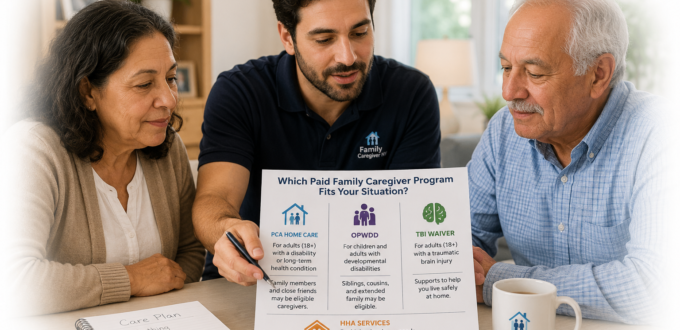
Which Program Fits Your Situation?
Before completing a full application, we first look at four things: your relationship to the patient, where the patient lives, whether Medicaid is active, and whether the patient has a long-term condition or developmental disability.
If the situation appears to qualify, the next step is the eligibility form. We connect qualified patients only with top, vetted, and reliable licensed Home Care agencies.
Not sure before applying? Call or text 929-660-2391 or use our contact page.
When the TBI Waiver May Apply
A traumatic brain injury can create long-term needs that do not fit neatly into standard Home Care. New York operates a separate Medicaid Home and Community-Based Services waiver for certain people with traumatic brain injuries.
To qualify for the TBI Waiver, an applicant generally must be enrolled in Medicaid, have a qualifying traumatic brain injury or related condition, require nursing-facility-level care, and be between the ages of 18 and 64 at the time of application. New York also requires that the qualifying injury occur after age 18.
The person must choose community living rather than placement in a nursing facility. Depending on the approved plan, services can include service coordination, respite, community integration counseling, independent living skills training, and other community-based supports.
The TBI Waiver should not be viewed as an automatic family caregiver pay program. Eligibility, services, and who can provide those services depend on the participant’s approved waiver plan and provider requirements.
Official program information is available from the New York State TBI Waiver program.
When HHA Home Care Is the Better Fit
Sometimes the main issue is not finding a family caregiver at all. The patient may need a qualified aide who can provide a higher level of Home Care support than a standard PCA assignment provides.
A Home Health Aide can provide personal care and certain health-related tasks under appropriate professional supervision. HHA Home Care may be appropriate when no eligible family caregiver is available or when the patient’s approved care needs require HHA-level services.
For qualified cases, we can connect the patient with a vetted, licensed Home Care agency that provides HHA services. We do not provide HHA training.
Medicaid Is an Important Part of the Decision
PCA Home Care and Medicaid-funded waiver services depend on the patient’s Medicaid eligibility and the requirements of the specific program.
If the patient does not currently have Medicaid, that does not necessarily end the conversation. Medicaid eligibility can be reviewed first, and qualified applicants may be connected with enrollment assistance through the licensed agencies we work with.
Our Home Care application process explains the general steps from initial screening through assessment and Start of Care.
The Caregiver Relationship Can Change the Answer
Two patients with similar health conditions can have very different options because their proposed caregiver relationships differ.
That is why we do not send every visitor directly into a long application. We first determine who will provide care, where the patient lives, whether Medicaid is active, and what type of condition is creating the need for assistance.
If the preferred relative does not qualify as the paid caregiver, the patient may still qualify for Home Care with another eligible relative, a trusted person, a PCA, or an HHA. The patient’s need for care and the caregiver’s employment eligibility are separate questions.
Frequently Asked Questions
Is there one paid family caregiver program in New York?
No. New York has different Medicaid-funded programs and Home Care pathways depending on the patient’s age, condition, functional needs, Medicaid status, and the requested services.
Which program is usually used for an older adult who needs help at home?
PCA Home Care is often the first pathway to review when an adult needs ongoing assistance with activities of daily living because of chronic illness, disability, mobility limitations, dementia, or age-related decline.
Which program should I look at for autism or another developmental disability?
OPWDD may be appropriate when the person has a qualifying developmental disability that occurred before age 22 and meets the agency’s eligibility requirements.
Does having a traumatic brain injury automatically qualify someone for the TBI Waiver?
No. The TBI Waiver has additional requirements involving Medicaid enrollment, age, diagnosis, nursing facility level of care, community living, and other program criteria.
Can any family member become the paid caregiver?
No. Caregiver eligibility depends on the program and provider pathway. The proposed caregiver’s relationship to the patient should be screened before completing the full eligibility process.
Does Family Caregiver NY offer CDPAP enrollment?
No. Family Caregiver NY does not offer CDPAP enrollment. We focus on PCA and HHA Home Care, OPWDD, and appropriate waiver referrals for qualified New Yorkers.