
If you are caring for someone at home in New York, one of the first questions you may have is simple: how much can a family caregiver actually get paid?
There is no single hourly rate for New York Medicaid caregivers that applies to every case. Pay depends on the Home Care program, the patient’s residence, the licensed agency employing the caregiver, the caregiver’s employment classification, and the number of authorized hours the patient actually receives.
For qualifying PCA Home Care cases, New York does not simply send the family caregiver a check. Medicaid funds authorized Home Care services, and the licensed Home Care agency employs and pays an approved caregiver through its payroll system once the case has been approved and the caregiver has completed the required onboarding.
Quick Answer: How Much Does New York Pay Family Caregivers in 2026?
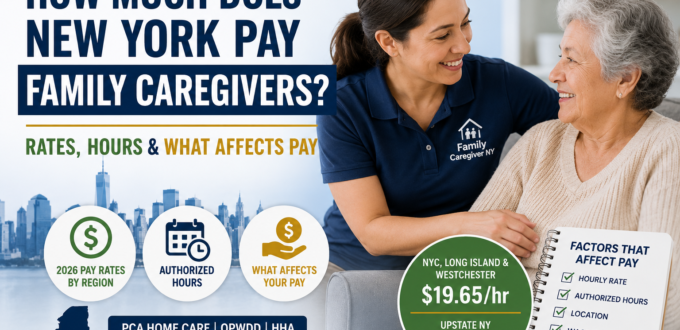
For workers covered by New York’s Home Care Aide minimum wage law, the minimum hourly rates effective January 1, 2026, are:
| New York Region | 2026 Home Care Aide Minimum Wage |
|---|---|
| New York City | $19.65 per hour |
| Long Island | $19.65 per hour |
| Westchester County | $19.65 per hour |
| Remainder of New York State | $18.65 per hour |
These are statutory minimum wage figures for covered Home Care Aides, not a promise that every family caregiver case will pay exactly that amount. An individual caregiver’s rate is determined by the licensed agency and the wage rules that apply to that employment arrangement.
You can verify the current rates directly through the New York State Department of Labor Home Care Aide minimum wage page.
For more information about how rates vary by case, see our Family Caregiver Pay Rates page.
There Is No Single NY Medicaid Family Caregiver Pay Rate
This is one of the most important things to understand when searching for the NY Medicaid caregiver hourly rate.
Medicaid does not provide a single paycheck to every family caregiver in New York. Medicaid pays for authorized services through the applicable Home Care system. The licensed agency then employs the caregiver and establishes the caregiver’s payroll rate in accordance with applicable wage, program, plan, and agency requirements.
That means two caregivers in different parts of New York may have different hourly rates, even when both work in Home Care.
The caregiver’s location can be particularly important because New York has different wage floors for New York City, Long Island, and Westchester compared with the rest of the state.
How Approved Home Care Hours Affect the Paycheck
The hourly rate is only half of the equation. The number of authorized and actually worked Home Care hours can have an even greater effect on the caregiver’s weekly gross pay.
A simple way to understand it is:
Hourly pay rate × hours actually worked = gross caregiver wages before taxes and deductions.
For example, a caregiver earning a hypothetical $20 per hour who works 20 authorized hours would have $400 in gross wages. At 30 hours, the same hypothetical rate would result in $600 in gross wages.
Those examples are for illustration only. They are not estimates or guarantees of the rate or number of hours a particular case will receive.
Who Decides How Many PCA Home Care Hours a Patient Receives?
The family does not simply choose the number of Medicaid Home Care hours it wants.
For people going through the applicable New York Medicaid Personal Care Services process, the New York Independent Assessor Program, commonly known as NYIAP, performs required assessments. The applicable Medicaid plan or local social services district then uses the required assessments and care-planning process to determine the services that can be authorized.
The assessment evaluates the patient’s actual functional needs, including the assistance required for activities of daily living such as bathing, dressing, toileting, mobility, and other personal care.
New York also has Minimum Needs Requirements that apply to many people seeking Personal Care Services on or after September 1, 2025. The exact standard depends on the person’s circumstances, including whether certain dementia or Alzheimer’s criteria apply.
You can review the official rules through the New York State Personal Care Services Program.
How to Make Sure the Home Care Assessment Reflects the Patient’s Real Needs
The goal of an assessment is not to maximize hours. It is to accurately document the level of assistance the patient genuinely requires.
Families should be prepared to explain what a typical day actually looks like rather than describing only the patient’s best days.
- Which daily activities require help?
- Does the patient need hands-on assistance or supervision?
- How often is assistance required?
- Have mobility or cognitive limitations changed?
- Are there recent medical records that document changes in function?
- Does the patient use a wheelchair, walker, transfer equipment, or another mobility aid?
Accurate information helps the assessment and care-planning process reflect the patient’s real condition. Families should never exaggerate limitations or create needs that do not exist.
Want to Know Whether Your Family’s Situation May Qualify?
Before sending you through a full application, we first look at four basic questions: your relationship to the patient, where the patient lives, whether the patient has Medicaid, and whether the patient has a long-term or ongoing condition.
If the situation appears to fit the PCA Home Care pathway, we can move you to the next step and connect qualified patients only with top-vetted, reliable licensed Home Care agencies.
Need to ask a question first? Call or text 929-660-2391 or use our contact page.
What Is New York Home Care Wage Parity?
Some Medicaid-reimbursed Home Care work performed in New York City, Nassau County, Suffolk County and Westchester County is also subject to New York’s Home Care Worker Wage Parity Law.
For covered Home Care Aides, the New York State Department of Labor currently lists a supplemental benefit component of:
- $4.09 per hour in New York City
- $3.22 per hour in Nassau, Suffolk, and Westchester counties
This should not automatically be added to a caregiver’s hourly pay when calculating expected cash pay. The wage parity requirement may be satisfied through wages, qualifying supplemental benefits, or a combination of both.
Examples can include certain health or other qualifying employee benefits, depending on how the employer structures compensation.
The current rules are available from the New York State Department of Labor Wage Parity page.
Can a Family Caregiver Earn Overtime?
Overtime can apply to covered Home Care employees, but it should not be assumed that receiving more than 40 authorized patient hours automatically means one caregiver will work all of those hours.
For covered non-residential employees, New York generally requires overtime compensation for work over 40 hours in a workweek. Certain residential employees have a 44-hour threshold. The employee’s exact overtime rights and rate depend on the employment arrangement and applicable state and federal rules.
The licensed Home Care agency also determines staffing and scheduling based on the patient’s authorization, employment rules, agency policy, and the needs of the case.
Gross Pay Is Different From Take-Home Pay
Once an eligible caregiver is formally hired by a licensed Home Care agency, the caregiver is generally an employee of that agency rather than someone receiving an informal payment from Medicaid.
That means the hourly rate shown is typically a gross wage before applicable payroll deductions.
- Federal income tax withholding, when applicable
- New York State and local taxes, when applicable
- Social Security and Medicare payroll taxes
- Other lawful payroll deductions or employee benefit contributions
For that reason, someone earning $20 per hour does not necessarily receive $20 in cash for every hour after payroll deductions.
What Actually Determines Family Caregiver Pay in New York?
When families ask how much New York pays family caregivers, these are the factors that matter most:
- Location: Different wage requirements apply in New York City, Long Island, Westchester and upstate New York.
- Licensed Home Care agency: Agencies establish their own employee pay structures subject to applicable wage laws and program requirements.
- Authorized services: The patient must first qualify for Medicaid-funded Home Care.
- Hours actually worked: Weekly gross wages depend heavily on the number of authorized hours the caregiver actually works.
- Caregiver eligibility: Not every family relationship qualifies under the PCA caregiver pathway we support.
- Wage parity: Covered Home Care work in certain downstate counties may include wage parity compensation requirements.
- Overtime: Overtime rules may affect compensation when a covered employee works enough hours to qualify.
PCA Pay Is Different From OPWDD Caregiver Pay
Not every family caregiver case is a PCA Home Care case.
For an adult with an ongoing physical condition, disability, dementia, mobility limitation, or age-related need for assistance, PCA or HHA Home Care may be appropriate.
For a child or adult with a qualifying developmental disability that began before age 22, OPWDD may be the more appropriate program. OPWDD has different services, staffing arrangements, reimbursement structures and caregiver requirements, so a PCA hourly rate should not automatically be applied to an OPWDD case.
If you are not sure which program applies, review our guide to the Home Care application process before moving forward.
Will New York Home Care Wages Increase Again?
New York has continued to raise minimum wages for home care workers. Under the current state wage structure, Home Care worker minimum wage adjustments are scheduled to become tied to inflation beginning in 2027.
That does not mean every caregiver’s agency rate will increase by the same amount. Future pay will still depend on the applicable wage requirements and the agency’s compensation structure.
Family Caregiver Pay Across Our New York Support Areas
Family Caregiver NY helps screen Home Care situations in New York City and a number of surrounding and upstate counties. Because wage requirements, Medicaid plans, agency availability and program options can vary by area, the patient’s location should always be checked before estimating caregiver pay.
Our support areas include Manhattan, Brooklyn, Queens, the Bronx, Staten Island, Nassau County, Westchester County, Albany County, Schenectady County, Fulton County, Warren County, Montgomery County, Washington County, Rensselaer County, and Saratoga County.
Frequently Asked Questions About Family Caregiver Pay in New York
How much does New York pay family caregivers per hour in 2026?
There is no single statewide family caregiver rate. For workers covered by New York’s Home Care Aide minimum wage law, the 2026 minimum is $19.65 per hour in New York City, Long Island, and Westchester County and $18.65 per hour in the remainder of New York State. Actual caregiver pay depends on the agency, program, location, and applicable wage requirements.
Does Medicaid pay the family caregiver directly?
In the PCA Home Care pathway discussed here, the caregiver is generally employed and paid by the licensed Home Care agency. Medicaid funds authorized Home Care services rather than simply issuing a personal caregiver allowance directly to the relative.
How much can a caregiver make per week?
Weekly gross wages depend primarily on the caregiver’s hourly rate and the number of authorized hours worked. There is no standard weekly paycheck for all New York family caregivers.
Does a more serious medical condition automatically mean more Home Care hours?
No. Authorization is based on the applicable assessment and care-planning rules, including the person’s functional needs and the assistance required with daily activities. A diagnosis by itself does not guarantee a specific number of hours.
Who determines PCA Home Care hours in New York?
NYIAP performs the required independent assessment for applicable cases. The Medicaid plan or local social services district then uses the required assessment and care-planning process when determining authorization. NYIAP alone does not simply assign the final weekly caregiver schedule.
Is wage parity extra cash added to the caregiver’s hourly rate?
Not necessarily. For covered workers, New York’s wage parity requirement can be satisfied through wages, qualifying supplemental benefits, or a combination of the two. It should not automatically be treated as extra cash on top of the stated hourly wage.
Can every relative get paid as a PCA caregiver?
No. Caregiver eligibility depends on the relationship to the patient, agency requirements and the applicable Home Care pathway. Family Caregiver NY screens the relationship before sending a case to the full eligibility form.